 Save
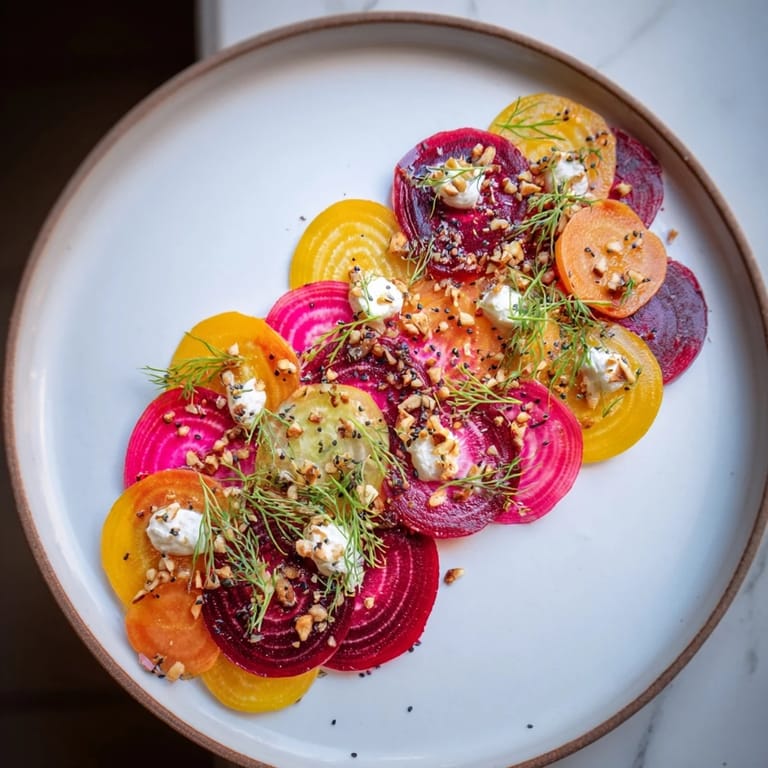
Save I discovered this dish at a dinner party where the host arranged vegetables with such intention that I couldn't stop staring at it before taking a bite. The way the colors clustered and then scattered across the plate felt like capturing movement itself in food. That night, I went home inspired to master this technique, and now it's become my favorite way to transform humble vegetables into something guests gasp at the moment it arrives.
I remember making this for a friend's birthday celebration, and she literally put her fork down for a full minute just to photograph it from every angle. By the time we finally ate, the goat cheese had warmed to the perfect creamy consistency, and everyone understood why I'd spent those extra minutes on the presentation. That's when I knew this wasn't just a pretty plate—it was magic.
Ingredients
- Golden beet: The sweetness here is delicate and earthy; I learned to slice them paper-thin so they're tender enough to eat raw without that dense, woody feeling. The color alone makes your plate glow.
- Red beet: This one's a bit more assertive in flavor, so the deep crimson creates visual drama that stops people mid-conversation when they see it.
- Watermelon radish: When you slice this open, those pink and white rings inside are pure theater. The flavor is mild and peppery, and it never fails to be a conversation starter.
- Persian cucumber: These are thinner-skinned and have fewer seeds than regular cucumbers, so they stay crisp and won't water down your platter as they sit.
- Baby carrots: I bias-cut them because it creates more surface area and makes them feel less utilitarian, more intentional.
- Creamy goat cheese: Room temperature is non-negotiable here—it should be spreadable and luxurious, not stiff or cold. This is what anchors the whole composition.
- Toasted hazelnuts: The toasting step is where magic happens; raw nuts are pleasant but toasted ones bring warmth and depth that makes people wonder what that subtle richness is.
- Black sesame seeds: These are mild and almost nutty, plus they add a striking visual contrast against the bright vegetables.
- Microgreens: I prefer arugula or radish microgreens for their peppery kick and delicate leaves that catch light beautifully.
- Fresh dill: The fronds only—no thick stems—because you want them to flutter slightly on the plate, adding movement to an already kinetic design.
- Extra virgin olive oil: This is your dressing's backbone, so use something you'd taste straight. The quality here matters more than anywhere else.
- Fresh lemon juice: Freshly squeezed, always. Bottled juice tastes flat against these delicate vegetables.
- Honey: Just a touch to round out the acidity and add a whisper of sweetness that ties everything together.
Tired of Takeout? 🥡
Get 10 meals you can make faster than delivery arrives. Seriously.
One email. No spam. Unsubscribe anytime.
Instructions
- Build your dressing first:
- In a small bowl, whisk together the olive oil, lemon juice, honey, salt, and pepper. Taste it on a vegetable slice—it should be bright and balanced, with the honey just barely noticeable. Set it aside and let the flavors marry while you work on the vegetables.
- Slice with intention:
- Use a sharp knife or mandoline to get your vegetables paper-thin and uniform. The slicing is where patience pays off; uneven cuts will break the visual rhythm you're about to create. I like to work through each vegetable type rather than random mixing.
- Create your dense cluster:
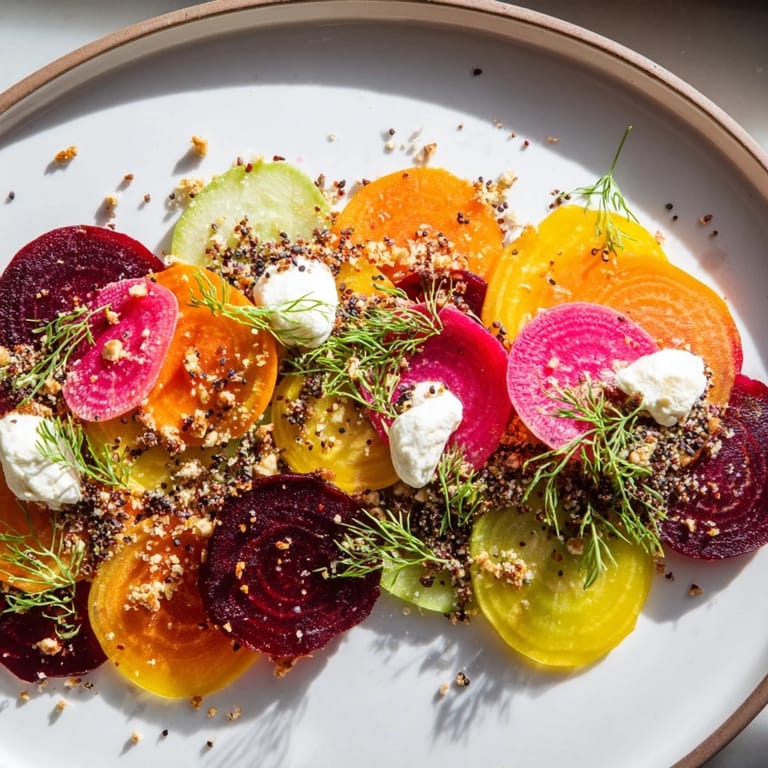
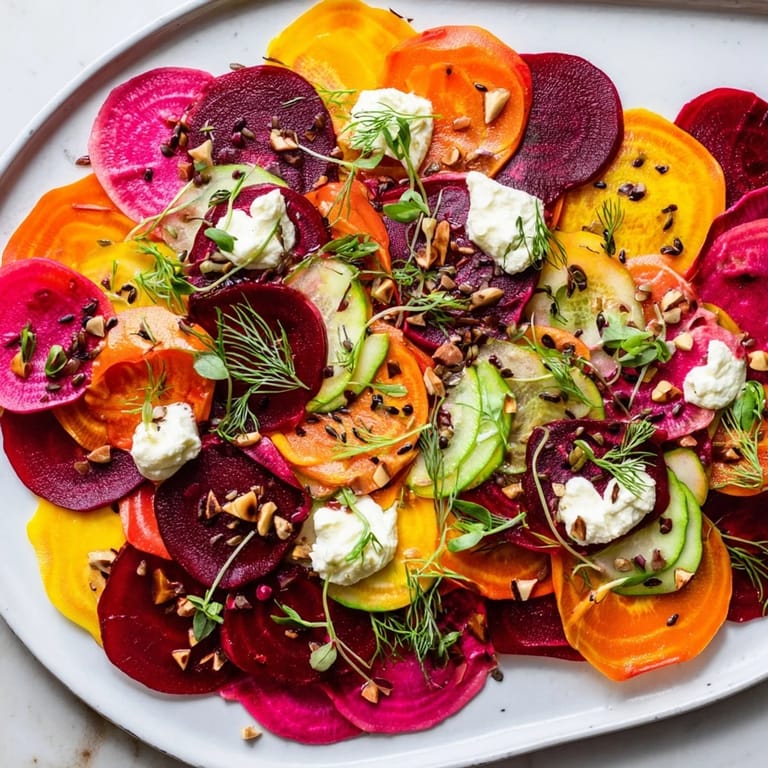
- On one side of your platter, begin overlapping the vegetable slices tightly, alternating colors to build visual interest. Think about how you'd arrange roof shingles—each slice slightly covering the previous one. This dense section is your focal point, so take your time and let the colors speak.
- Fade toward motion:
- As you move across the platter, gradually space the slices further apart, creating distance between them. This transition from tight to scattered is the heart of the kinetic effect—it's what makes the eye travel and gives the whole composition a sense of movement frozen in time.
- Dot the goat cheese:
- Using a small spoon, place tiny dollops of goat cheese among the densest cluster, letting them nestle into the crevices between vegetable slices. As you move toward the sparse side, use fewer dollops and space them further apart, following the same fade pattern.
- Scatter the nuts and seeds:
- Sprinkle the toasted hazelnuts and black sesame seeds, concentrating them where the vegetables are densest, then trailing off toward the edge. These add texture and catch light in ways that enhance the kinetic illusion.
- Add the finishing greens:
- Scatter the microgreens and dill fronds last, placing them mostly among the dense area but allowing a few delicate leaves to float toward the sparse side. They should feel placed, not random, even though they're lighter than the other elements.
- Dress and serve:
- Just before serving, drizzle the dressing across the platter with a light hand, using less on the sparse side to maintain the visual effect. The dressing should enhance but never overshadow the arrangement. Serve immediately while everything is crisp and the visual impact is maximum.
 Save
Save The first time someone told me this was the most beautiful appetizer they'd ever seen, I felt something shift. Food isn't just about taste—it's about the moment you create, the pause before the first bite, the way it makes people lean in closer. That's what this dish taught me.
The Mandoline Is Your Friend
If you don't own a mandoline, this is your sign to invest in one. A sharp knife works, but the mandoline gives you consistency that makes the whole presentation sing. The vegetable slices will be uniform, the light will play across them evenly, and your kinetic effect will actually feel intentional rather than happy accident. I learned this the hard way after my first attempt looked more chaotic than kinetic.
Playing with Seasonal Vegetables
The vegetables I've listed are beautiful and accessible year-round, but this dish loves variety. In spring, I use thin asparagus spears and pea shoots. In summer, I add heirloom tomato slices and fresh mint. In fall, roasted beet varieties and pomegranate seeds work magic. Winter invites thinly sliced celery root and preserved lemon. The arrangement technique stays the same; only the colors and flavors shift with the seasons, keeping this dish fresh in your rotation.
Dressing Variations and Wine Pairings
The simple lemon dressing I've given you is perfect, but once you master it, you can explore. A balsamic reduction creates earthiness for fall versions. A champagne vinaigrette adds elegance if you're serving this at a cocktail party. A yogurt-based dressing transforms it into something more substantial if you're serving it as a light lunch. As for wine, a crisp Sauvignon Blanc is my first choice—its acidity mirrors the lemon in the dressing. A dry sparkling wine works beautifully too, especially if you add smoked salmon for a pescatarian twist. The key is something that cleanses the palate between bites and doesn't overpower the delicate vegetables.
- Make extra dressing—people always want more than you'd expect, and it keeps separately for up to three days
- If serving at a party, arrange everything an hour ahead except the dressing and greens, then finish five minutes before guests arrive
- Don't skip the toasting step for hazelnuts; it's the difference between pleasant and memorable
 Save
Save This dish taught me that sometimes the most impressive food is the simplest—just raw vegetables, good technique, and intentional arrangement. It's a reminder that in the kitchen, like in life, presentation and presence matter.
Recipe Help
- → What produces the motion blur effect on the plate?
The effect comes from arranging sliced vegetables and toppings densely on one side, gradually spacing them out to create a fading visual gradient.
- → Which ingredients add texture to the dish?
Toasted hazelnuts and black sesame seeds sprinkled over the arrangement provide crunchy contrast to the soft vegetables and cheese.
- → How is the dressing balanced for this dish?
A simple mix of extra virgin olive oil, fresh lemon juice, honey, salt, and pepper is whisked together and drizzled lightly to complement without overpowering.
- → Can this dish accommodate dietary variations?
Yes, plant-based cheese can replace goat cheese for vegan diets, and smoked salmon or trout can be added for pescatarian options.
- → What tools aid in achieving the precise slices?
A sharp chef's knife or mandoline is recommended to thinly slice vegetables uniformly for optimal presentation and texture.